

- This event has passed.
CEA’s Proposed Energy Storage Mandate for Renewable Energy Projects
India’s rapid expansion of solar and wind power is increasing the need for greater flexibility, grid stability and firm renewable energy capacity. Against this backdrop, the Central Electricity Authority (CEA) has proposed new draft regulations that would require eligible renewable energy projects commissioned after July 2027 to integrate Energy Storage Systems (ESS).
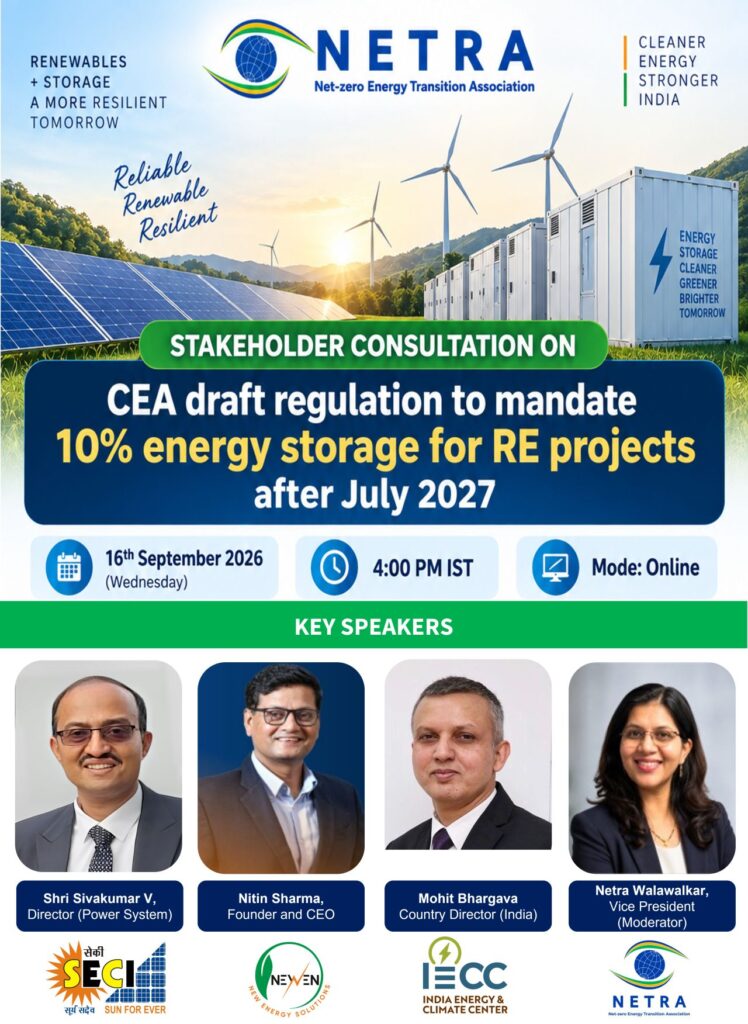
Under the draft framework, ground-mounted solar and wind power projects commissioned after July 2027 would be required to install energy storage with a minimum capacity equivalent to 10% of the renewable energy plant’s installed capacity, along with a minimum storage duration of two hours.
The proposed regulations also envisage progressively stronger storage requirements. Projects commissioned after July 2029 and up to June 2031 would be required to incorporate energy storage with a minimum duration of four hours, reflecting the growing need for longer-duration flexibility as renewable energy penetration increases across the Indian power system.
The proposal comes at a time when India’s electricity grid is facing increasing challenges in managing variable renewable energy generation. High solar output during daytime hours, combined with limitations in grid flexibility and demand absorption, can result in renewable energy curtailment. Energy storage can help address this challenge by shifting excess generation to periods of higher demand, reducing curtailment and supporting more efficient utilization of renewable energy assets.
Beyond storage requirements, the CEA draft also proposes that at least 15% of inverters used in renewable energy power plants commissioned after July 2027 should incorporate grid-forming controls. Grid-forming inverters can play an important role in supporting voltage and frequency stability as the share of inverter-based renewable generation rises within the electricity system.
These proposed changes could have significant implications for renewable energy developers, BESS manufacturers, inverter suppliers, EPC companies, utilities, system operators and investors. While mandatory storage can improve grid resilience and support renewable energy integration, its implementation will need to carefully consider project economics, technology readiness, procurement timelines and the availability of suitable storage solutions.
NETRA convened a stakeholder consultation to examine the implications of the proposed CEA framework and gather industry perspectives on how mandatory energy storage and grid-forming requirements can be implemented effectively.
The discussion brought together experts from the renewable energy and energy storage ecosystem, including:
Shrine Sivakumar Vepakomma, Director (Power Systems), Solar Energy Corporation of India Limited (SECI)
Nitin Sharma, Founder & CEO, Newen Systems Pvt. Ltd.
Mohit Bhargava, Country Director, India Energy & Climate Center (IECC)
Netra Walawalkar, Vice President, NetZero Energy Transition Association — Moderator
The consultation focused on the appropriate scale and duration of storage, implications for project costs and tariffs, technology choices, grid-forming capabilities, implementation timelines and the readiness of India’s renewable energy and storage ecosystem.
The policy challenge lies in ensuring that energy storage requirements strengthen grid reliability and renewable energy integration without creating unnecessary barriers to project development. A well-designed and phased framework can encourage greater deployment of BESS and other storage technologies while providing developers and manufacturers with sufficient visibility to plan investments and build capabilities.
As India moves towards a power system with a substantially higher share of renewable energy, integrating energy storage and advanced grid-forming technologies will become increasingly important. Developing a predictable regulatory framework will therefore be critical to ensuring that renewable energy growth is supported by the flexibility and reliability required for a resilient clean-energy grid.