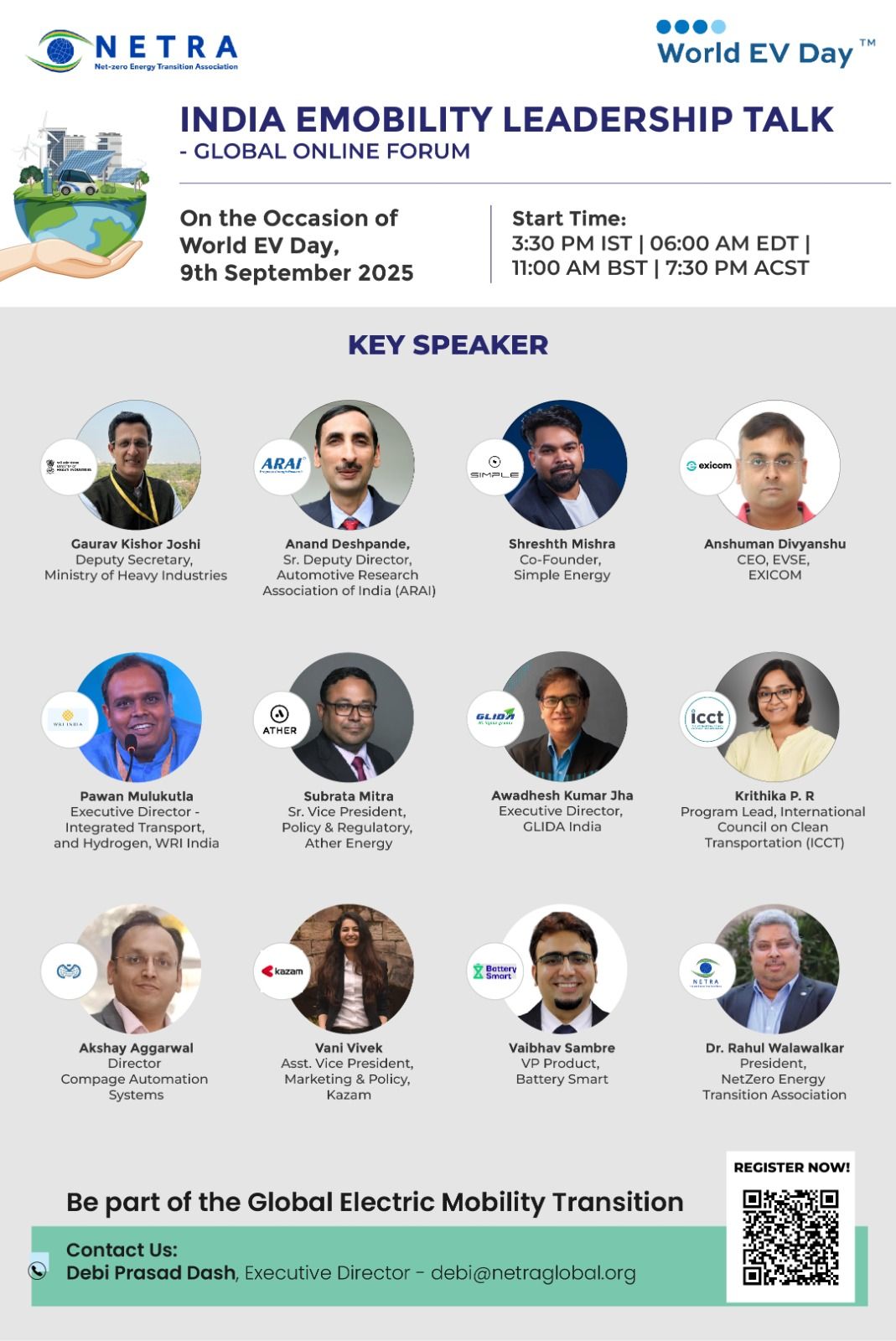

At our recent session on EV Mobility Collaboration and Benchmarking, industry leaders, policymakers, and experts came together to discuss how India can accelerate its EV journey through stronger collaboration, transparency, and global benchmarking.
Highlights from the discussion:
Benchmarking & Data Transparency: Calls for Charge Point Operators (CPOs) to consistently share data and benchmark performance.
Collaboration Opportunities: Partnerships suggested with consulting groups and think tanks to align DISCOMs, CPOs, and research institutions.
Battery Manufacturing: Urgent need for India to advance domestic cell manufacturing, supported by technology exchange and global collaboration.
Global Learning: Engagements with international think tanks will help accelerate the ecosystem’s maturity.
✨ Collaborative Pathways Forward:
1️⃣ Government – Provide long-term policy visibility (2–5 years ahead) to boost investor confidence and create a level playing field.
2️⃣ Industry Leaders – Invest in domestic R&D, address supply chain vulnerabilities, and develop “Born EV” designs.
3️⃣ Manufacturing Stakeholders – Localize critical EV components (motors, battery packs, power electronics) under PLI and PM E-drive schemes.
4️⃣ Regulator – Lead on safety standards, certification, and next-gen benchmarking frameworks.
5️⃣ Research Institutions – Leverage research funding to pursue disruptive technologies, especially advanced storage beyond chemical batteries.
6️⃣ Ecosystem Collaboration – Form research consortia and centers of excellence to avoid redundant efforts, accelerate innovation.
🚀 The Road Ahead: India’s EV sector is at an inflection point. Collaboration, openness, and global benchmarking will determine how quickly we move from being adopters to becoming leaders in clean mobility innovation.
At NETRA, we remain committed to enabling these dialogues and fostering collaborative action for a net-zero mobility future.