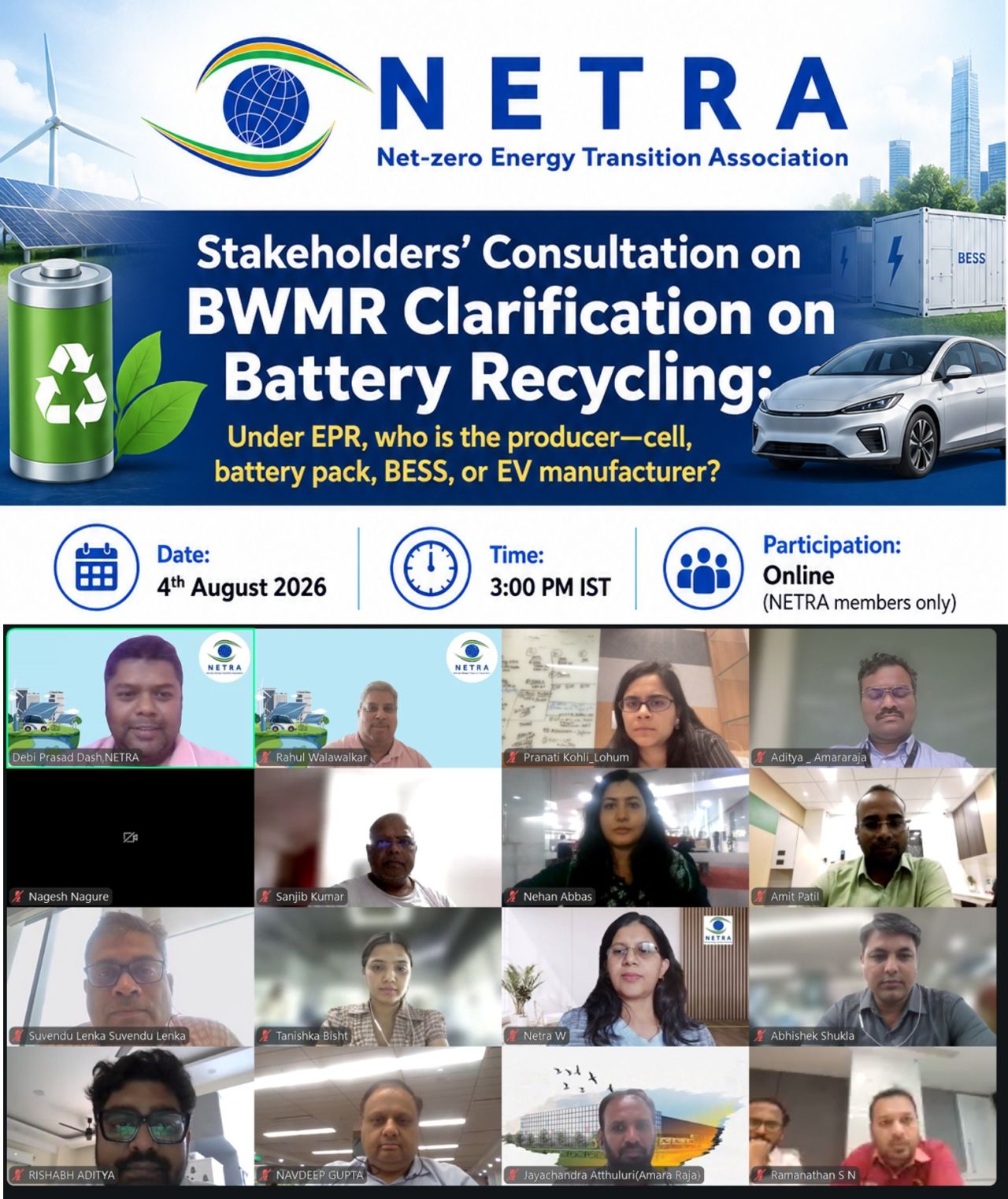

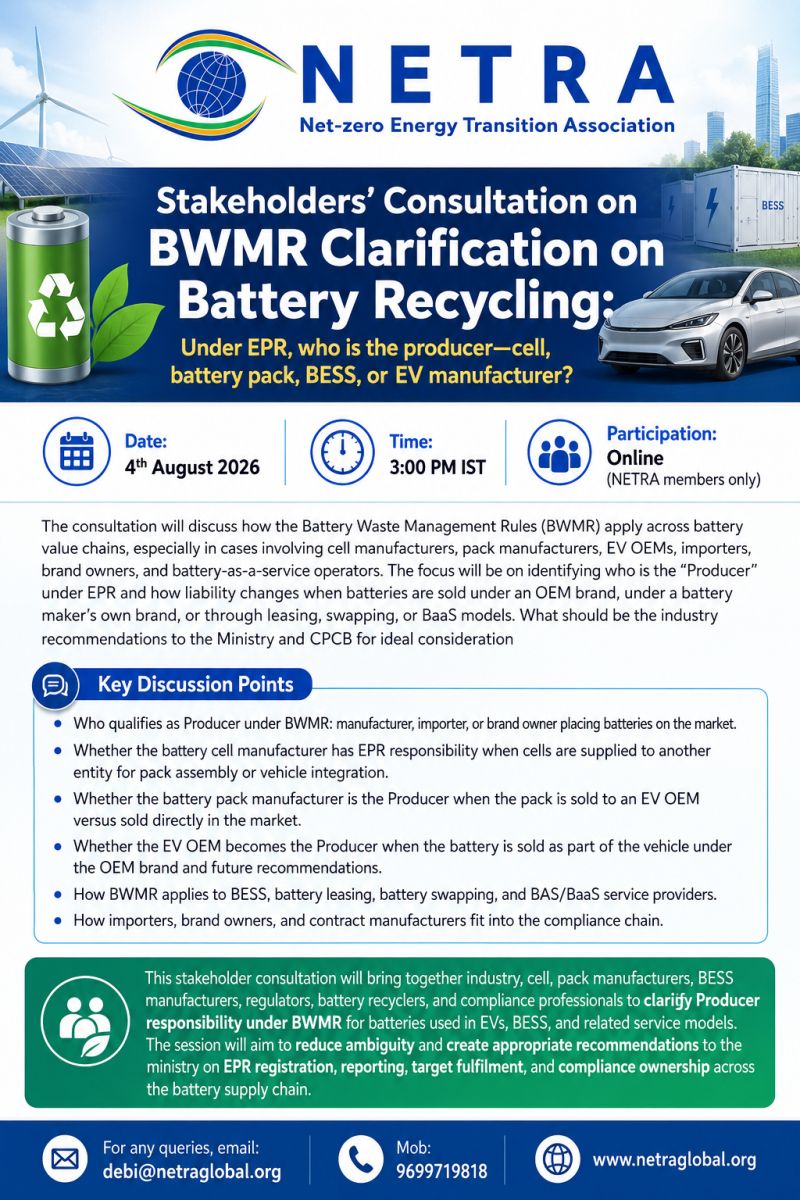
The NetZero Energy Transition Association (NETRA) convened a stakeholders’ consultation to discuss the applicability of Extended Producer Responsibility (EPR) obligations under the Battery Waste Management Rules (BWMR), 2022, across India’s battery manufacturing, deployment, and recycling value chain.
The consultation focused on clarifying producer responsibilities, addressing regulatory ambiguities, and examining compliance requirements for stakeholders involved in battery manufacturing, importing, distribution, usage, and end-of-life management.
The session provided a platform for industry representatives to identify implementation challenges and develop practical recommendations for consideration by the Ministry of Environment, Forest and Climate Change (MoEFCC) and the Central Pollution Control Board (CPCB).
Industry Background and Regulatory Context
India’s rapidly expanding electric mobility, renewable energy, and battery energy storage sectors have increased the importance of establishing a robust and transparent battery waste management framework.
The Battery Waste Management Rules, 2022, introduced an Extended Producer Responsibility framework designed to ensure environmentally sound collection, recycling, and refurbishment of waste batteries.
Under this framework, entities classified as producers are responsible for meeting prescribed obligations related to waste battery management, including registration, recycling and refurbishment targets, and associated compliance requirements.
However, the diverse structure of India’s battery value chain has created questions regarding the applicability of EPR obligations to different industry participants.
Battery cell manufacturers, pack assemblers, electric vehicle original equipment manufacturers (OEMs), importers, brand owners, Battery Energy Storage System (BESS) developers, and battery-as-a-service operators may participate in different stages of battery production, ownership, and deployment.
These overlapping roles have raised important questions about producer classification, responsibility allocation, compliance procedures, and the potential for duplication of obligations across the value chain.
Key Discussion Areas
The stakeholder consultation focused on four critical areas of EPR implementation:
- Producer Classification and Responsibility: Examining how producer obligations under the Battery Waste Management Rules apply to battery cell manufacturers, pack manufacturers, EV OEMs, importers, brand owners, BESS operators, and battery-as-a-service providers.
- EPR Compliance and Regulatory Clarity: Identifying ambiguities in registration requirements, reporting obligations, EPR targets, and compliance procedures for different participants in the battery value chain.
- Responsibility Allocation Across the Value Chain: Assessing potential overlaps in producer responsibilities and exploring approaches to prevent duplication of compliance obligations while maintaining accountability for end-of-life battery management.
- Policy Clarification and Industry Recommendations: Discussing practical regulatory interpretations and developing recommendations for MoEFCC and CPCB to support transparent, consistent, and effective implementation of the EPR framework.
Stakeholder Participation
The consultation was designed to engage representatives from across India’s battery and energy storage ecosystem, including:
- Battery cell manufacturers
- Battery pack manufacturers and assemblers
- Electric vehicle OEMs
- Battery importers and brand owners
- Battery Energy Storage System (BESS) developers and operators
- Battery-as-a-service and battery-swapping companies
- Battery recycling and refurbishment companies
- Industry associations, regulatory experts, and policy stakeholders
The consultation sought to incorporate perspectives from different segments of the battery value chain to ensure that proposed clarifications reflected practical industry requirements.
Consultation Objective
The primary objective of the consultation was to facilitate industry-wide dialogue on EPR obligations and establish greater clarity regarding producer responsibilities under the Battery Waste Management Rules, 2022.
The discussion aimed to identify regulatory uncertainties, examine compliance challenges faced by different stakeholders, and explore solutions that could simplify implementation without compromising environmental accountability.
The consultation also sought to consolidate industry feedback into actionable recommendations for consideration by MoEFCC and CPCB, supporting a more consistent and transparent regulatory framework for battery waste management.
Significance for India’s Battery Recycling Ecosystem
As India scales up domestic battery manufacturing, electric mobility, and energy storage deployment, effective implementation of Extended Producer Responsibility is essential for developing a sustainable battery lifecycle management system.
Clear regulatory definitions and well-defined compliance responsibilities can help minimise administrative burdens, reduce uncertainty, improve accountability, and encourage greater investment in formal recycling and refurbishment infrastructure.
A predictable EPR framework can also strengthen material recovery, promote resource efficiency, and support the development of a circular battery economy while reducing environmental risks associated with improper battery disposal.
Through this stakeholder consultation, NETRA reinforced its commitment to facilitating industry–government dialogue, addressing regulatory challenges, and supporting evidence-based policy development for India’s battery recycling and circular economy ecosystem.
Key Focus Areas: Extended Producer Responsibility (EPR) | Battery Waste Management Rules (BWMR) | Battery Recycling | Producer Obligations | CPCB Compliance | EV Batteries | Battery Energy Storage Systems (BESS) | Circular Economy | Battery Lifecycle Management