

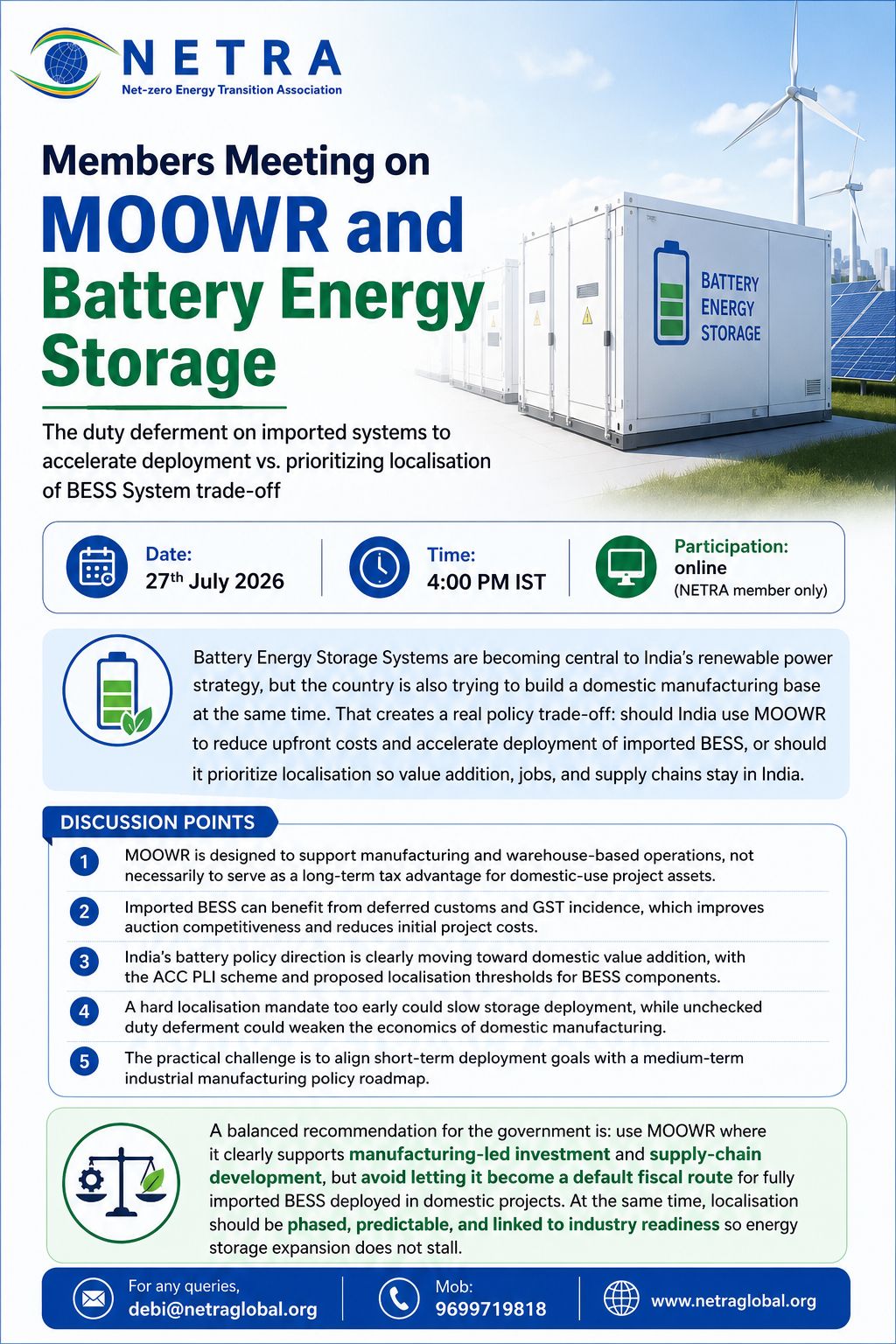
The NetZero Energy Transition Association (NETRA) convened a members’ meeting on 27 July 2026 to discuss the implications of the Manufacturing and Other Operations in Warehouse Regulations (MOOWR) framework for India’s Battery Energy Storage System (BESS) sector.
The meeting focused on a critical policy consideration: balancing the fiscal advantages of imported battery energy storage systems with India’s long-term objective of developing a competitive domestic BESS manufacturing ecosystem.
As India accelerates renewable energy integration and energy storage deployment, policies governing customs duties, manufacturing incentives, and domestic value addition are becoming increasingly important in shaping investment decisions and industry competitiveness.
The session provided a platform for NETRA members to examine the implications of duty deferment under MOOWR, assess its potential impact on domestic manufacturing, and explore policy approaches that could support both affordable energy storage deployment and indigenous industrial development.
Industry Background and Policy Context
Battery Energy Storage Systems are becoming essential to India’s energy transition by enabling greater renewable energy integration, supporting grid flexibility, and improving power system reliability.
However, the rapid expansion of energy storage capacity presents a significant policy challenge. While imported BESS equipment can help reduce project costs and accelerate deployment, India is simultaneously pursuing domestic manufacturing capabilities to strengthen supply-chain resilience, generate employment, and increase local value addition.
The Manufacturing and Other Operations in Warehouse Regulations (MOOWR) framework enables eligible entities to undertake manufacturing and other permitted operations in bonded warehouses, with deferment of applicable customs duties on imported goods, subject to prescribed conditions.
For the BESS industry, the potential application of this framework raised questions about the fiscal treatment of imported systems, project competitiveness, and the implications for domestic manufacturers.
At the same time, India’s Advanced Chemistry Cell (ACC) Production Linked Incentive (PLI) Scheme and proposed localisation requirements for BESS components reflect a broader policy direction towards strengthening indigenous battery manufacturing.
The interaction between these policy instruments highlighted the need for a coordinated approach that supports near-term energy storage deployment without undermining long-term domestic manufacturing investments.
Key Discussion Areas
The members’ meeting focused on five critical policy and industry considerations:
- MOOWR Framework and Regulatory Applicability: Examining the intended scope of the MOOWR framework and its application to manufacturing, warehousing, and imported BESS equipment used in domestic energy storage projects.
- Customs Duty Deferment and Project Economics: Assessing how duty deferment under MOOWR could influence upfront capital requirements, project costs, bidding competitiveness, and the commercial viability of BESS deployment. The discussion also considered applicable indirect tax implications.
- Domestic Manufacturing and Localisation: Evaluating the potential impact of imported BESS systems on indigenous manufacturing investments, domestic value addition, employment generation, and supply-chain development.
- Balancing Deployment and Industrial Development: Examining the risks associated with premature localisation mandates, which could increase costs or delay project execution, alongside the potential disadvantages of prolonged fiscal benefits for imported systems.
- Policy Alignment and Implementation Roadmap: Exploring how customs regulations, manufacturing incentives, localisation requirements, and energy storage deployment targets could be aligned through a phased and predictable policy framework.
Stakeholder Participation
The online meeting was organised exclusively for NETRA members, with discussions relevant to stakeholders across India’s battery manufacturing and energy storage ecosystem, including:
- Battery Energy Storage System developers
- Battery cell and component manufacturers
- BESS system integrators and equipment suppliers
- Renewable energy project developers
- Engineering, Procurement and Construction (EPC) companies
- Domestic battery manufacturing and supply-chain companies
- Industry representatives working on taxation, customs regulations, and manufacturing policy
The meeting aimed to facilitate a balanced exchange of perspectives between stakeholders focused on accelerating BESS deployment and those investing in India’s domestic manufacturing capabilities.
Consultation Objective
The primary objective of the meeting was to examine the policy trade-offs associated with applying MOOWR benefits to imported battery energy storage systems and identify approaches that could support India’s energy storage deployment and manufacturing ambitions.
A central policy consideration was whether duty deferment mechanisms should primarily support manufacturing-led investments and supply-chain development rather than becoming a default fiscal advantage for fully imported BESS equipment deployed in domestic projects.
The discussion also explored the importance of introducing localisation requirements through a phased, predictable, and industry-aligned approach.
Such a framework would need to consider domestic manufacturing readiness, technology availability, cost competitiveness, supply-chain capabilities, and India’s energy storage deployment requirements.
The meeting sought to facilitate industry dialogue and develop policy perspectives that could inform recommendations to relevant government authorities.
Significance for India’s Energy Storage and Manufacturing Ecosystem
India’s energy transition requires the simultaneous expansion of affordable battery energy storage capacity and the development of a resilient domestic battery manufacturing industry.
While imports can address immediate deployment requirements and support competitive project pricing, long-term dependence on overseas equipment and components may limit domestic value creation and expose the sector to global supply-chain risks.
Conversely, localisation requirements introduced without adequate consideration of manufacturing readiness and market conditions could increase project costs, constrain equipment availability, and slow energy storage deployment.
A balanced policy approach can help align fiscal incentives with domestic manufacturing objectives while ensuring that energy storage projects remain commercially viable.
Through this members’ meeting, NETRA continued its efforts to facilitate informed industry dialogue, examine emerging policy challenges, and contribute to evidence-based recommendations supporting India’s battery energy storage and manufacturing ecosystem.
Key Focus Areas: MOOWR | Battery Energy Storage Systems (BESS) | Customs Duty Deferment | Domestic Manufacturing | Battery Localisation | ACC PLI Scheme | Domestic Value Addition | Energy Storage Policy | Supply-Chain Development | Make in India