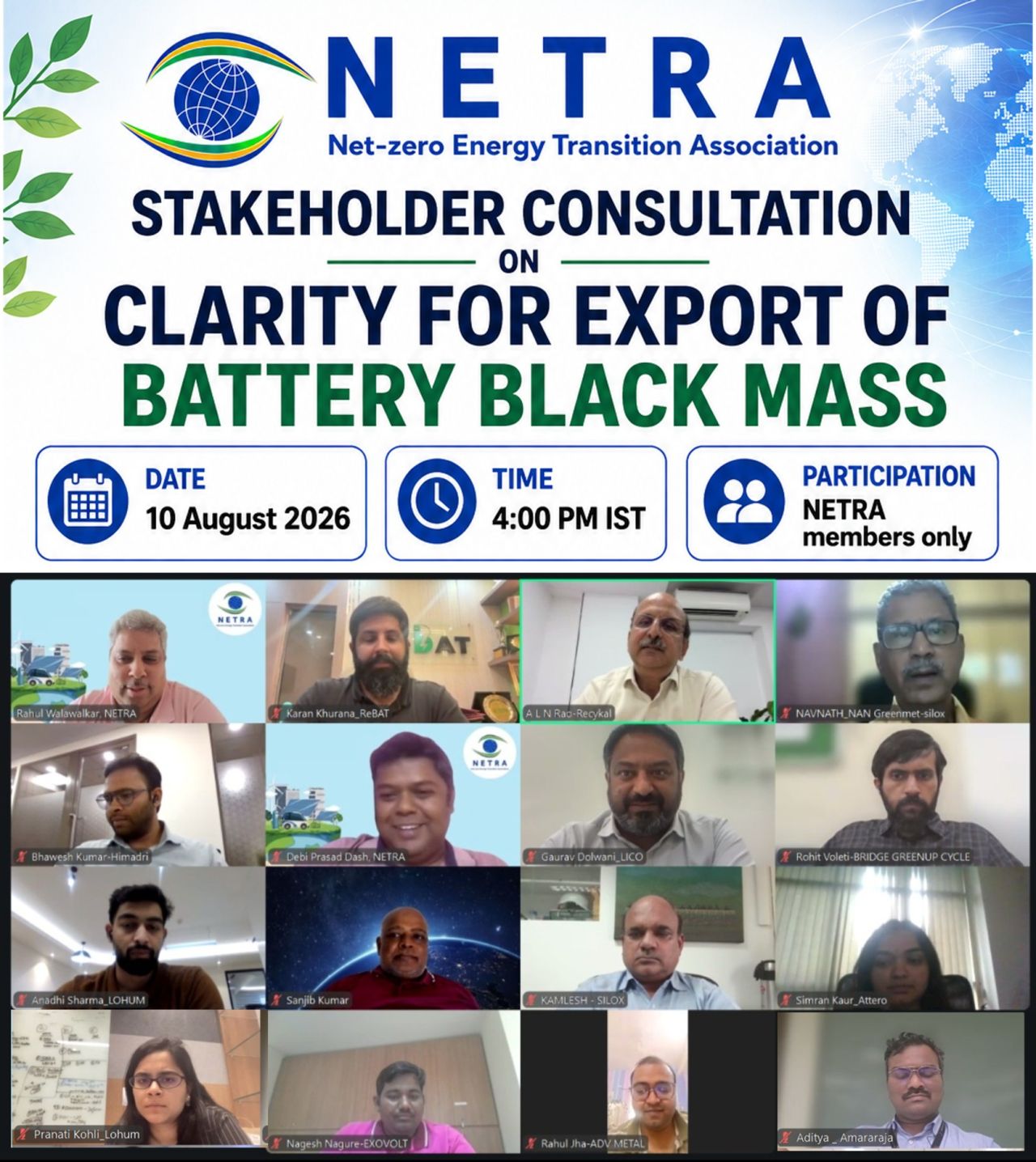

The NetZero Energy Transition Association (NETRA) convened a stakeholder consultation on 10 August 2026. Moreover, it discussed policy clarity regarding the export of battery black mass from India and its Domestic Refining implications.
The consultation addressed regulatory uncertainties and evaluated Domestic Refining capabilities.
Additionally, it examined India’s critical mineral security, battery recycling, and circular economy goals, and explored a balanced export policy.
Additionally, the discussion provided a platform for industry stakeholders to examine the implications of existing regulatory provisions.
It also contributed recommendations for a demand-linked, differentiated export framework.
Industry Background and Policy Context
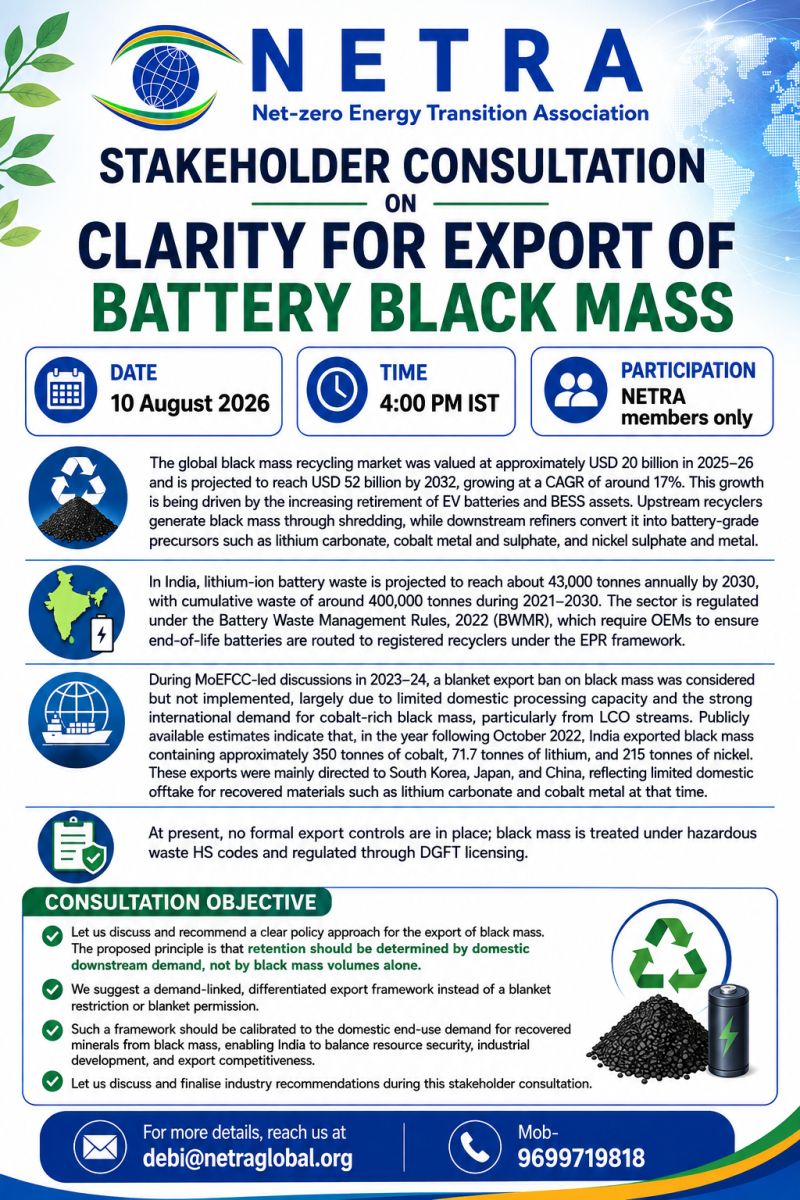
The global battery black mass recycling market, a facet of Domestic Refining, was estimated at USD 20 billion in 2025–26.
Additionally, projections show growth to USD 52 billion by 2032.
This expansion is driven by end-of-life EV batteries and Battery Energy Storage Systems.
Black mass comes from the mechanical processing and shredding of used lithium-ion batteries.
Additionally, it contains valuable materials such as lithium, cobalt, nickel, and graphite.
In India, annual lithium-ion battery waste generation was projected to reach approximately 43,000 tonnes by 2030.
Additionally, the cumulative waste is estimated at around 400,000 tonnes between 2021 and 2030.
Moreover, the Battery Waste Management Rules, 2022, established an Extended Producer Responsibility (EPR) framework. It requires producers to ensure the collection and recycling of end-of-life batteries through registered recyclers.
However, limited Domestic Refining capacity and evolving demand for recovered critical minerals have created policy challenges.
Additionally, these issues surround the export of black mass.
Earlier policy discussions during 2023–24 considered restrictions on black mass exports. However, they emphasized balancing domestic resource retention with the viability of recycling operations and access to international markets.
Key Discussion Areas
Firstly, the stakeholder consultation centered on four key policy considerations.
- Export Policy Clarity: Examining regulatory uncertainties surrounding battery black mass exports and the need for a transparent, predictable policy framework.
- Domestic Downstream Demand: Assessing how domestic demand for recovered lithium, cobalt, nickel, and other critical minerals should influence export permissions and resource retention requirements.
- Differentiated Export Framework: Exploring a demand-linked export approach that distinguishes between materials required by domestic refiners and those without sufficient domestic processing capacity or offtake.
- Critical Mineral Security and Industry Competitiveness: Evaluating how export regulations can support India’s recycling ecosystem, encourage downstream investments, and maintain the international competitiveness of domestic recyclers.
Consultation Objective
The consultation aimed to facilitate industry consensus. As a result, it will support a balanced policy approach for battery black mass exports.
A central proposal for discussion is that domestic retention requirements should be based on actual downstream demand for recovered minerals. Moreover, it should not depend on the total volume of black mass generated.
The proposed approach advocated a demand-linked, differentiated export framework.
However, it rejected blanket export restrictions or unrestricted permissions.
Such a framework would account for domestic refining capabilities, mineral-specific demand, recycling economics, and evolving industrial requirements.
The consultation also sought to consolidate stakeholder perspectives into industry recommendations.
Additionally, these recommendations were prepared for consideration by relevant government authorities.
Significance for India’s Battery Recycling Ecosystem
As India expands its electric mobility and energy storage sectors, developing an efficient battery recycling ecosystem remains important.
Moreover, critical mineral recovery is essential to support this growth.
Clear and predictable export policies can support investment in recycling infrastructure, improve domestic resource utilization.
Moreover, they strengthen critical mineral supply chains and enable Indian companies to participate competitively in global markets.
Through this stakeholder consultation, NETRA continued its efforts to facilitate industry–government dialogue.
Moreover, it contributed to evidence-based policies supporting India’s energy transition and circular economy.
Key Focus Areas include Battery Black Mass, Battery Recycling, and Critical Minerals.
Additionally, Export Policy, Extended Producer Responsibility (EPR), Lithium-ion Batteries, Circular Economy, and Energy Storage are highlighted.
Domestic Refining is also a key focus.