

India’s Battery Energy Storage Systems sector (BESS) is entering a critical growth phase. Energy storage is increasingly important for renewable energy integration. It also supports grid flexibility, peak demand management, and overall power reliability.
Against this backdrop, the Ministry of Power’s proposed local-content requirements have brought renewed focus to the need for a strong domestic manufacturing ecosystem across key components such as Battery Management Systems (BMS), Energy Management Systems (EMS), battery containers, and cells.
Local Content Requirements (LCR) can strengthen domestic manufacturing for BESS. They also develop indigenous technological capabilities, create long-term industrial value, and reduce India’s dependence on imported energy storage components.
Greater localization can also improve supply-chain resilience and encourage investments across the wider battery and energy storage value chain.
However, the design and implementation of such requirements will be critical.
A localization framework must account for the current maturity of domestic manufacturing capabilities. It should ensure that BESS projects remain commercially competitive, technologically reliable, and deployable within required timelines.
An overly rigid or immediate localization mandate could increase project costs or constrain deployment. A well-sequenced approach can support both industrial growth and energy storage expansion.
Key considerations include the methodology for calculating local content in integrated BESS projects. This requires clear criteria for how localization is measured and applied. The discussion also covers imported components and finished products. It addresses verification, compliance mechanisms, and the phasing of localization across the value chain.
Additionally, the framework should specify how localization requirements apply to different parts of the value chain. For BESS projects, sequencing and timing matter to balance cost, risk, and local capability. Finally, auditors should verify data accuracy and ongoing compliance across suppliers and modules.
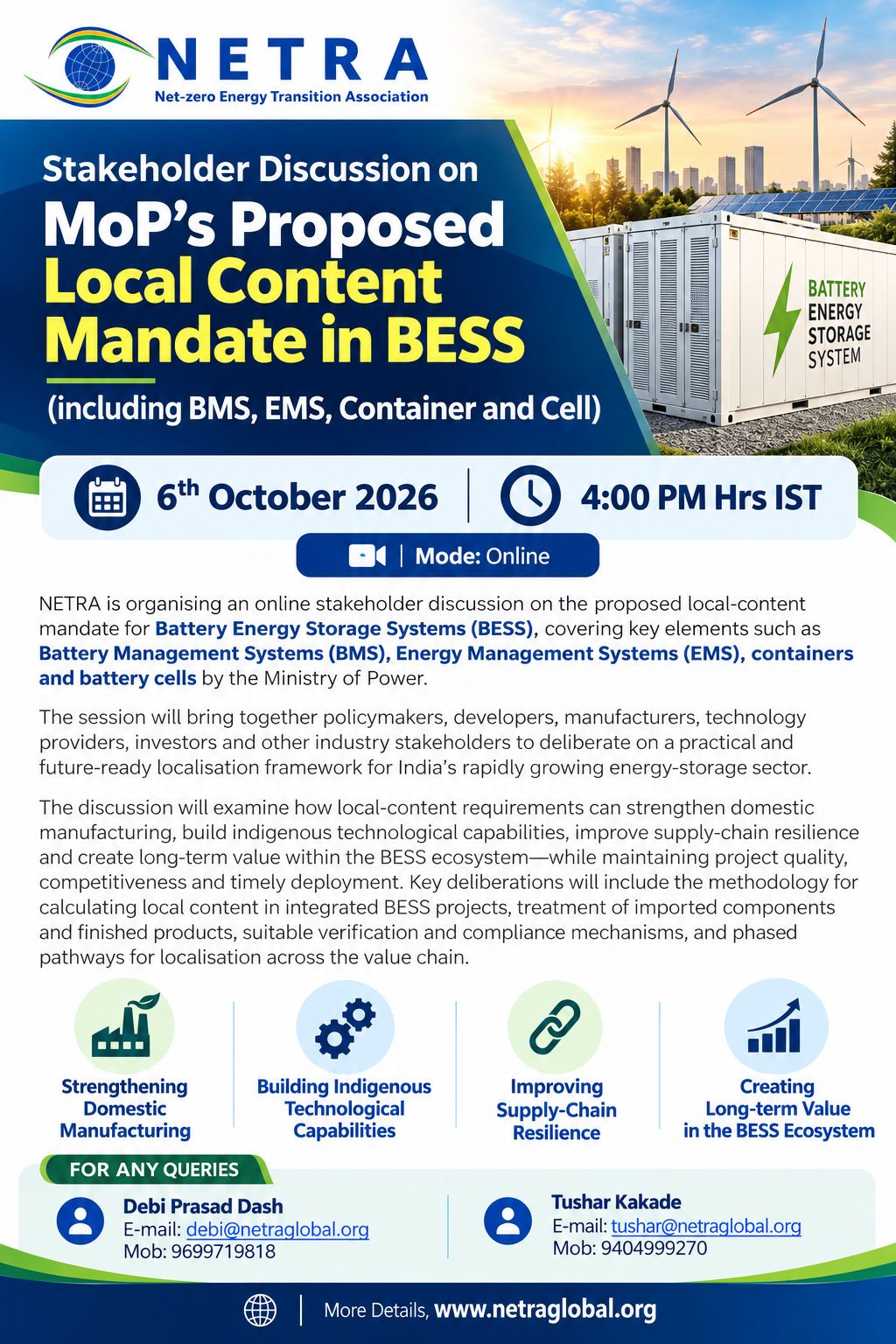
NETRA Global’s stakeholder discussion will bring together policymakers, developers, manufacturers, technology providers, investors, and other industry stakeholders to discuss the roles of government, industry, and research institutions in shaping the energy storage sector’s development in India for long-term, sustainable growth.
Additionally, it will deliberate on a practical and future-ready localization framework for India’s rapidly growing energy storage sector, incorporating inputs from industry, government, and academia. The discussion aims to align policy, procurement, manufacturing, and innovation to accelerate local supply chains and support domestic capacity building.
The way forward uses a calibrated, phased approach with clear milestones. It supports domestic manufacturing and technology development to boost capability. It preserves cost competitiveness, project quality, and deployment momentum across programs. This approach aligns policy, funding, and supplier readiness for steady progress.
Achieving this balance will be essential for building a resilient, self-reliant BESS ecosystem that can support India’s long-term clean energy transition. Moreover, it requires coordinated action among government, industry, and financiers. Stakeholders must align on standards, supply chains, and skill development to sustain momentum.